Nimble Accounting.
Designing a clearer operating model for multi-business accounting, automation, reconciliation and reporting.
Explore the case study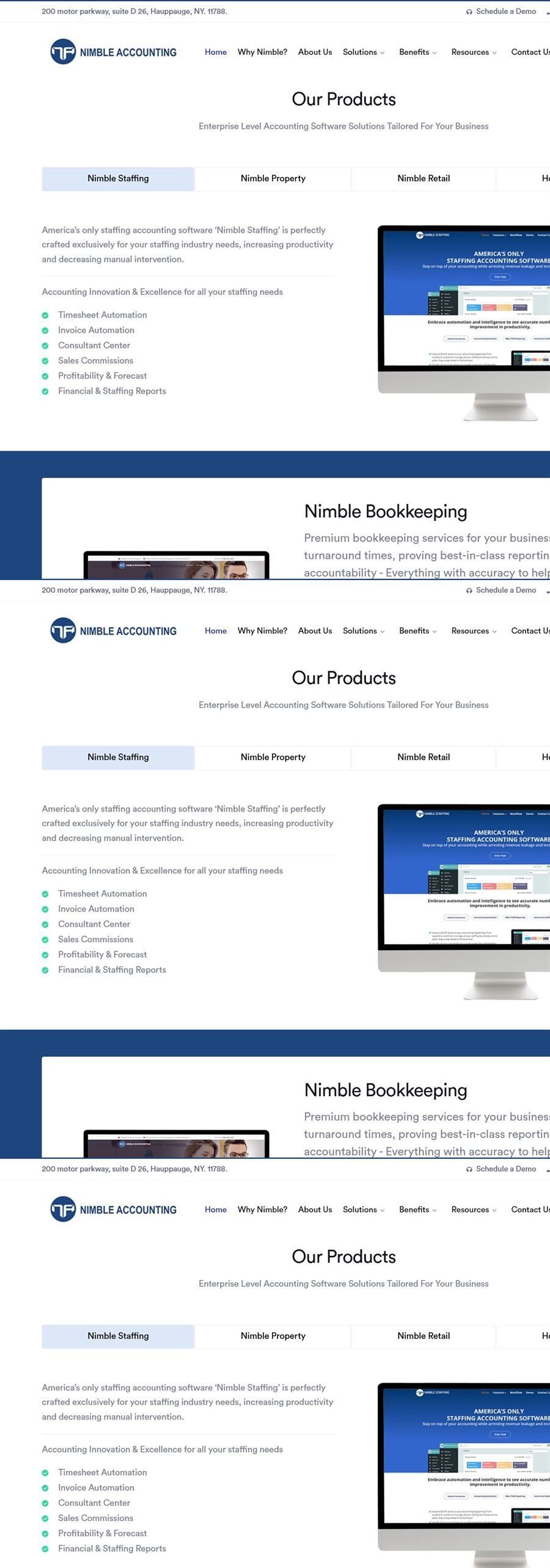
Accounting software shaped around real operational complexity.
Nimble positions its ecosystem around automation, seamless integrations, reduced spreadsheet dependency and industry-specific accounting solutions.
VIEW SOURCEOne system, many financial contexts.
Accountants and business teams need to move between entities, understand performance, reconcile activity and generate reports without losing context or confidence.
Multi-entity clarity
Keep the active business visible and reduce the risk of completing work in the wrong entity.
Decision-ready dashboards
Turn dense financial information into a hierarchy that highlights status, exceptions and next actions.
Connected workflows
Make automation, reconciliation, payables and reporting feel like one connected system rather than separate tools.
Different roles. One shared financial truth.
The experience must support distinct levels of financial expertise while keeping terminology, status and system behavior consistent.
Accuracy and throughput
- Reconcile efficiently
- Resolve exceptions
- Generate dependable reports
Performance and control
- Understand financial health
- Compare business entities
- Identify what needs attention
Visibility and accountability
- Track work status
- Support clients consistently
- Reduce manual follow-up
Structure first. Standards next. Prototypes throughout.
A practical contribution model connecting user needs, financial information hierarchy and implementation-ready behavior.
Role-based needs
Mapped the priorities and language of accounting users, business owners and service teams.
Information hierarchy
Organized navigation and dashboard content around high-frequency financial tasks and exceptions.
Reusable patterns
Established consistent behavior for filters, status, tables, forms and financial summaries.
Working prototypes
Used responsive HTML/CSS prototypes to communicate interaction and implementation intent.
Confidence is a design requirement.
Financial interfaces must reduce uncertainty before they add speed. These principles guided the reconstructed design direction.
Always show context
Keep the active entity, period and workflow status visible.
Lead with exceptions
Prioritize items requiring attention over passive totals.
Explain system status
Use clear language for automated, pending, matched and completed states.
Reveal detail progressively
Support scanning first and deeper financial inspection second.
From overview to reconciliation.
A representative reconstructed journey showing how one task can move from financial signal to completed action.
Confirm the active entity and accounting period.
Scan health, exceptions and incomplete tasks.
Filter the items requiring verification.
Match, explain or flag each exception.
Review a dependable reporting snapshot.
Financial information made scannable.
Low-fidelity reconstructions communicate a proposed information architecture without presenting them as original historical deliverables.
Small interface decisions, large confidence gains.
The strongest accounting experiences make critical state visible and reduce the number of decisions users must hold in memory.
Persistent entity context
The active business remains visible in task-heavy screens.
Unambiguous status language
Text and color work together so meaning never depends on color alone.
Progressive financial hierarchy
Headline information leads to supporting context and detailed records.
Public product context, framed honestly.
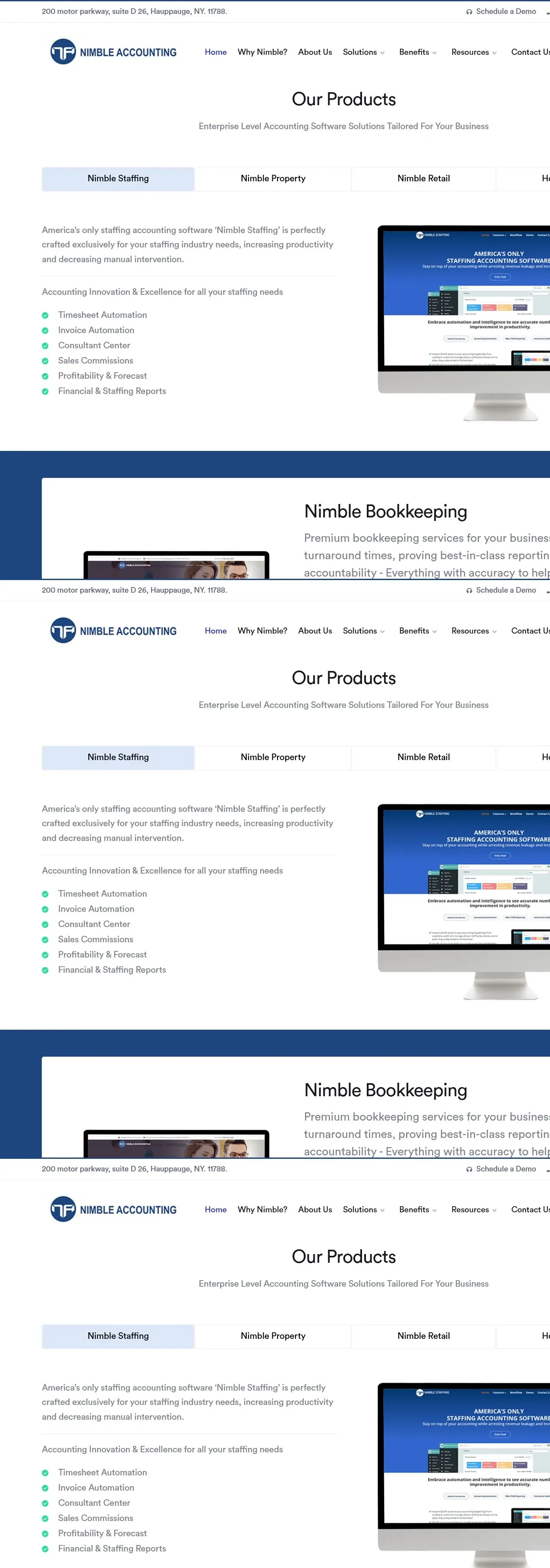
The current public-facing experience provides visual evidence of Nimble’s product ecosystem. Internal authenticated screens are not represented as publicly verified artifacts.
Less uncertainty. More financial control.
Without access to historical product analytics, outcomes are stated as design intent rather than fabricated performance claims.
Faster orientation
Users can identify the active business, financial period and next task more quickly.
Clearer exception handling
Unresolved transactions become visible, actionable work instead of hidden system state.
More consistent delivery
Shared patterns support clearer handoff and more predictable behavior across modules.
In accounting products, clarity is not visual decoration—it is part of the trust model.